The artwork animates itself
The verdict on the rig was blunt and correct: the ears never truly belonged to the head, the head was no longer the same drawing, and no amount of joint code was going to fix either. This round began with research into how the problem is actually solved by people who solve it for a living, and ended with a different machine doing the in-betweening: the original artwork, never redrawn, never cut, moving between its own poses. Every clip worked on the first attempt.
Why the rig could not get there
The professional reference for making a single illustration move is the Live2D and cut-out pipeline, and its documentation is explicit about the two things the rig violated. First, parts are separated FROM the master drawing, never drawn fresh, and the artist then paints in the areas that were hidden, so the character survives its own motion. Second, where a part meets the body, the join is drawn with deliberate overlap; a part that merely sits on top will always read as attached rather than grown. The v5 fox failed both: its head was a new generation rather than the master, and its ears were parked on a skull that was never drawn to receive them.
Doing it properly by hand was researched and rejected, for an honest reason.
The correct manual pipeline exists: segment the master, inpaint what each part hides, deform with small amplitudes. But its quality rests on an artist's judgment at every seam, and four rounds had already shown where handcraft against this artwork tops out. The strategy that removes the seam problem entirely is to never create seams.
The alternative was already written down in this house. The Shmili animation research identified start-and-end-frame conditioning as the single biggest lever for AI character motion: give a video model two stills, where the shot starts and where it ends, and it must interpolate a real change instead of improvising drift. That advice had never been tested on our own material. The fox owns fourteen poses of one character in one style, which is exactly a keyframe library, and the API it names supports precisely this.
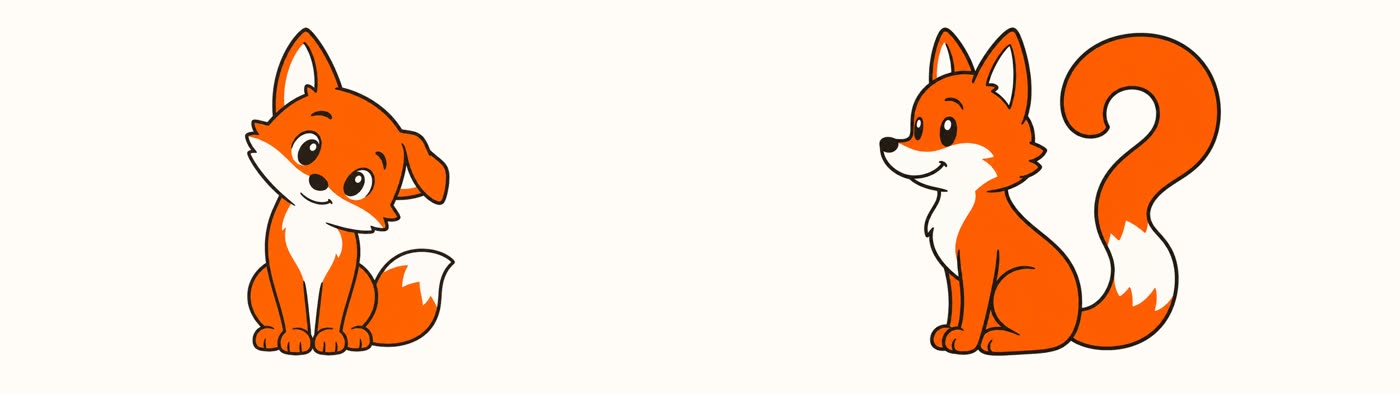
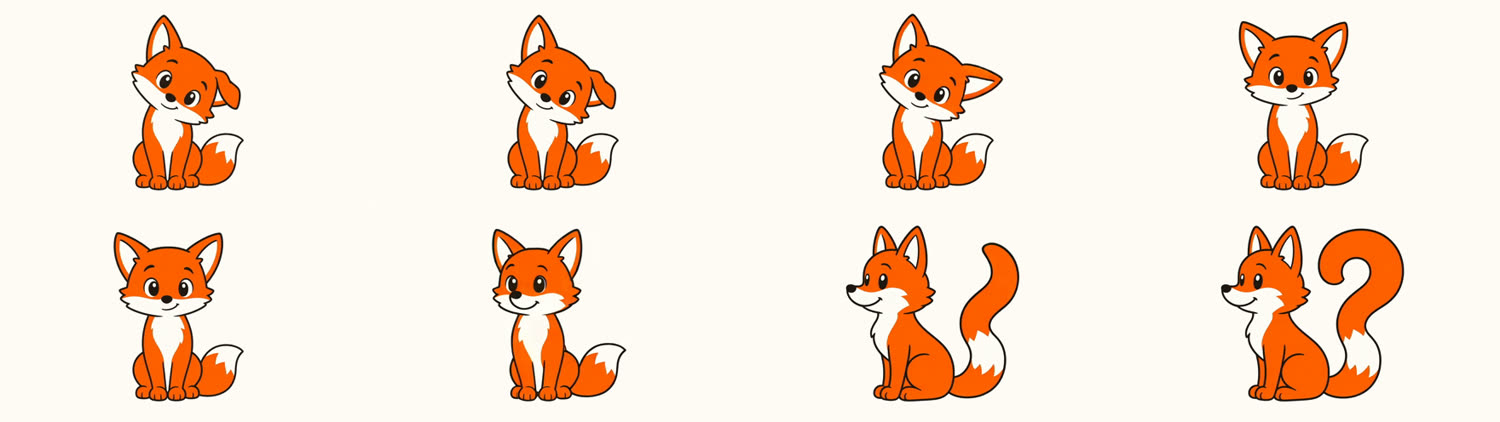
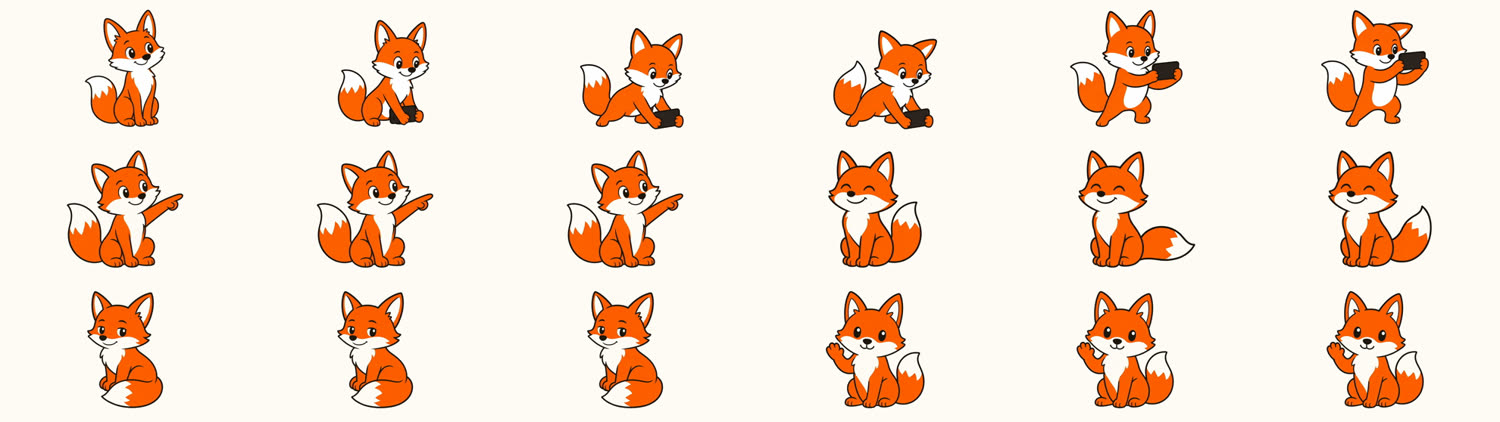
Four shots, four first attempts
| Complaint on v5 | How this approach dissolves it |
|---|---|
| The ears are not connected well | The ears are never separated from the head, in any frame. They are pixels of the same drawing, moving with it. |
| The shape of the head changed | The head is the shipped artwork's head in every frame of every clip, because the inputs to every shot ARE the shipped artwork. |
| It does not feel natural | The in-betweening comes from a model trained on how bodies actually move, not from thirty hand-set tween curves. The turn to camera in the wave shot is motion the rig could not represent at all. |
The master artwork is sacred. When a character must move a little, deform the master gently and hide nothing. When it must move a lot, do not rebuild it from parts: give a motion model the master's own poses as start and end, and let it in-between. The craft that survives from the rig rounds is direction, not puppetry: choosing the shots, the beats, the timing, and the sound.
Nothing from v2 to v5 was wasted
The film around the clips is everything the earlier rounds learned. The shots are staged on the brand cream at matched registration, so the clips cut together as one film. The prompts follow the house discipline: one action with a beginning and an end, timeline phrasing, no mood words, the style guard inline. The sound survives: the shutter click lands where he raises the phone, the typing ticks under the search, the chime under the wordmark. And the end card breathes with a slow push-in, because the moving hold rule does not care how the picture was made.
Cost and methodWhat it took
Run on 22 August 2026. Start and end stills staged from the shipped pose library onto brand cream at 1280 by 720 with matched registration. Generation: Vidu start-end-to-video on viduq3-turbo, 4 seconds at 720p per shot, 44 credits each, 176 credits for the film, one attempt per shot. Assembly, typography, sound and render: the same local toolchain as every previous round, 22 seconds at 1080p with the synthesized soundtrack. The research and the verdicts were also written into the character animation advisor, so the strategy change outlives this page.
Where this goes
- A walking shot. The gait knowledge from v4 becomes a prompt, not a rig: two poses and "he walks from the left" is now the cheap version of five strides of joint code.
- A voice. Still the largest untouched lever.
- Vertical. The same four shots re-staged at 9 by 16 for where the audience actually is.
Press Notes at the bottom right to mark up any block, or click any line to edit it directly.
Back to the topic · v5, the rig's last round · v4, the literature · v3, the rig · v2, the poses · v1, the pipeline · All explorations