The fox does the work
The first film proved the pipeline. It was also a slideshow with a mascot stapled to the end. This one gives the character the story: he wonders, he trots in, he takes the photograph, he points at the answer, he is pleased with himself. Same free toolchain, same machine, twenty three seconds, six hundred and ninety frames rendered in sixteen. The difference is not the tool. It is that a pose library turned an illustration into a performer.
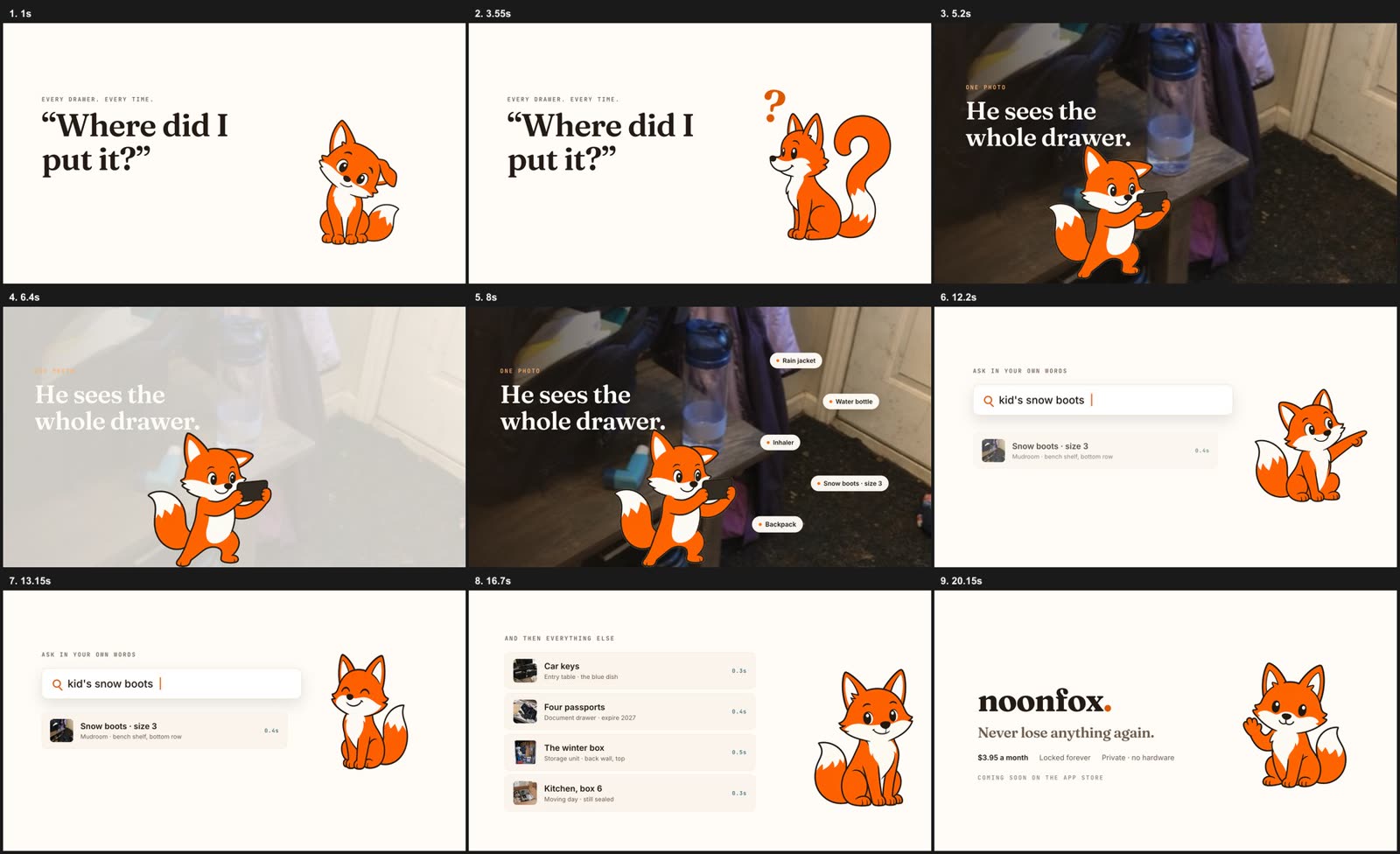
Twenty three seconds, five acts, one character
The problem. He sits confused, tips his head twice, and his tail curls into a question mark on the beat. The question mark is a pose, not a graphic.
The snap. He trots in from the left holding the phone, plants, the shutter fires, the scan sweeps and five items label themselves around him. He flinches at the last one.
The find. The search types itself. He arrives already pointing, the answer drops in under his paw, and he hops twice about it.
The escalation. Four more answers stack, each landing faster than the last, while the camera leans in five percent. He stands over the pile.
The card. He falls into frame, squashes on landing, settles on a spring and wags. Then the price.
A pose library beats a better renderer
The tool did not change between the two cuts. What changed is that the fox stopped being one image. The character exploration from earlier this year left a set of fourteen cut out poses, and six of them do all the work here: confused, tail question, phone, pointing, pleased and waving.
A pose set is what separates a mascot from a performer.
One image can only be moved. A set can be ACTED, because the swap itself carries meaning: the fox changing from confused to tail question is a thought, not a transition. The swap always lands on the impact frame of a hop, never between beats, which is the oldest rule in hand drawn animation and it survives intact in a browser.
| Technique | Where it is, and why it matters |
|---|---|
| Anticipation | Every hop dips before it rises. Motion without a wind up reads as a glitch rather than an intention. |
| Squash and stretch | Tall and narrow at the top of a hop, wide and short on landing, with the origin at the fox's feet. The origin is the whole trick: centred, it looks like a resize. |
| Overshoot and settle | Springs rather than eases on every landing and every recoil, so nothing arrives dead. |
| Pose swap on impact | Confused becomes tail question at the bottom of a hop. Pointing becomes pleased on a landing. Never mid air. |
| Trot cycle | Eight vertical bobs across the slide in, with a small lean that returns to zero. A slide with no bob reads as a sticker on a rail. |
| Follow through | The body keeps going a beat after the feet stop, on a spring with a low damping value. |
| Breathing | A slow two percent vertical scale under every held pose. A character that holds perfectly still reads as a sticker. |
| Escalating rhythm | Five chips then four rows, each entrance shorter than the one before it, into a five percent camera push. |
None of this is a video feature. It is eight animation principles expressed as transforms on a timeline, in a file you can read and diff. The renderer contributed nothing except turning it into frames, which took sixteen seconds.
The cut rate is not what makes it exciting
The obvious way to make a film livelier is to cut faster. That was avoided on purpose. This cut has five scenes in twenty three seconds, which is slower per scene than the first version, and it plays as considerably more alive.
Excitement comes from contrast, anticipation, escalation and the reveal.
That rule came out of a completely different project, an animated children's show, where the research is unambiguous: fast cutting measurably harms young viewers and the beloved shows are deliberately uncutty. It transferred without modification to a product launch film, which is a good sign that it is a real rule about attention rather than a rule about children.
So the structure does the work instead. Act one is quiet and still. Act two is dark, loud and moving. Act three answers a question. Act four escalates one answer into four, each faster than the last, under a slow camera push. Act five lands.
The film uses the corrected palette from the accessibility work of the same day: the deeper orange for display type and the darker one for anything small. The checker also caught the timing labels sitting at 4.3 to 1 against the panel fill, under the body floor, which is a colour pairing the site itself uses. Both were fixed before this rendered.
What a third version would test
- Sound. This is still silent, and sound is the largest remaining lever by a distance. A shutter, a soft landing, one music bed.
- The other eight poses. Detective, ground search, peek and look back are all in the library and unused. They are a second act waiting to be written.
- Vertical. Nine by sixteen from the same source, which is a layout change here rather than a re edit.
Run on 22 August 2026 on an Apple M4 desktop. HyperFrames 0.8.8, headless Chrome and FFmpeg. 690 frames rendered in 16.0 seconds. Six poses from the fourteen pose cut out set produced for the character exploration; every other asset was captured from the live site by the tool. The checker passed with zero errors, and its one remaining warning is the deliberate fifty millisecond camera flash.
Press Notes at the bottom right to mark up any block, or click any line to edit it directly.
Back to the topic · v1, the pipeline proved · All explorations