The fox, animated properly
The verdict on the last cut was better but far from elegant, and the fix was not more animation, it was the animation literature. This version is built on what animators have known since the fifties: a walk is a four beat gait, a planted foot must never ease, the body is lowest just after each footfall, nothing above the hips moves in unison, and a character that is truly still is dead. Every one of those rules is now in the file, with the research behind each.
Five rules from the literature, and where each landed
| Rule | Source | In this film |
|---|---|---|
| A walk is a four beat gait | Quadruped locomotion references: each foot lands on its own beat in lateral sequence, front and back legs as two offset systems. The trot in v3, both diagonals together, is why it bounced like a toy. | Each leg runs a quarter stride behind the last. Front legs swing less than back legs, because the front carries the head and chest. |
| Never ease a planted foot | Rigged animation practice (Spine): easing while a foot touches the ground is the direct cause of skating. The ground moves at one speed; the foot on it must too. | The stance sweep is linear, only the airborne swing is eased, and stance takes 62 percent of the stride. In act four the steps are short, so stride length and swing amplitude shrink together, which is the ratio that keeps feet honest. |
| Down after contact, up at passing | Williams, The Animator's Survival Kit: the body is lowest just after the foot lands and highest as the legs pass. And the parts arrive in order: hips first, chest about two frames later, head two frames after that. | The bob is no longer a sine wave: a quick drop after each footfall, a slower rise to passing. The head runs the same curve 140 milliseconds late, which is the single change that most separates v4 from v3. |
| Overlap, drag, follow through | Thomas and Johnston, The Illusion of Life: appendages move at different rates during motion, drag behind it, and keep moving after the body stops, settling in sequence. | The tail is now three nested joints. Walking, it carries a wave: base leads, mid follows 90 milliseconds later, tip 180. Stopping, the whip travels outward and the tip settles last, over a full second. |
| The moving hold | Animation Mentor, AnimSchool: a pose held dead still reads as lifeless the moment it stops. Life in a hold is breath, small eye movement, and parts still settling. | No frame of this film is still. Every hold carries breathing, a slow tail sway in the outer joints, saccades, and blinks placed where the gaze changes direction, which is where real blinks happen. |
One stride, and one settle
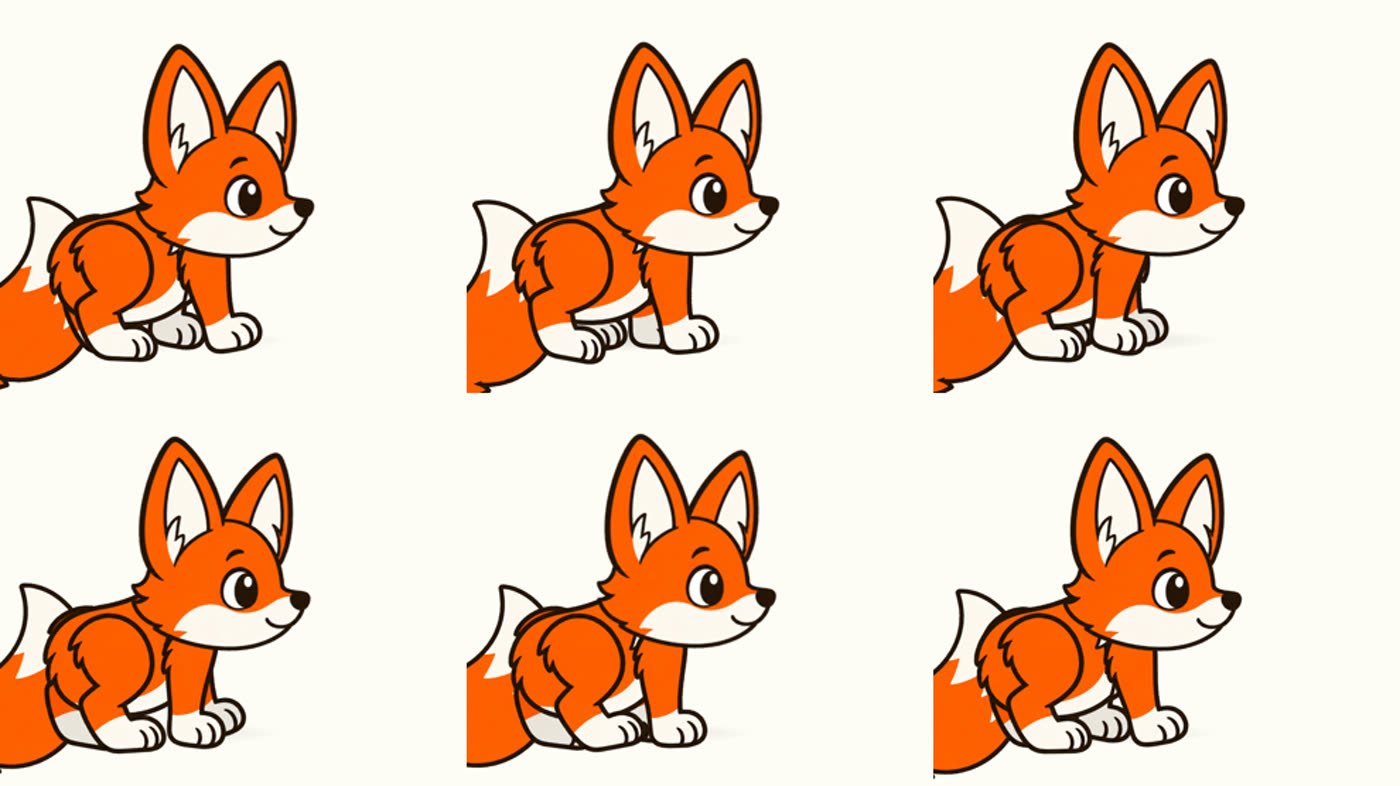
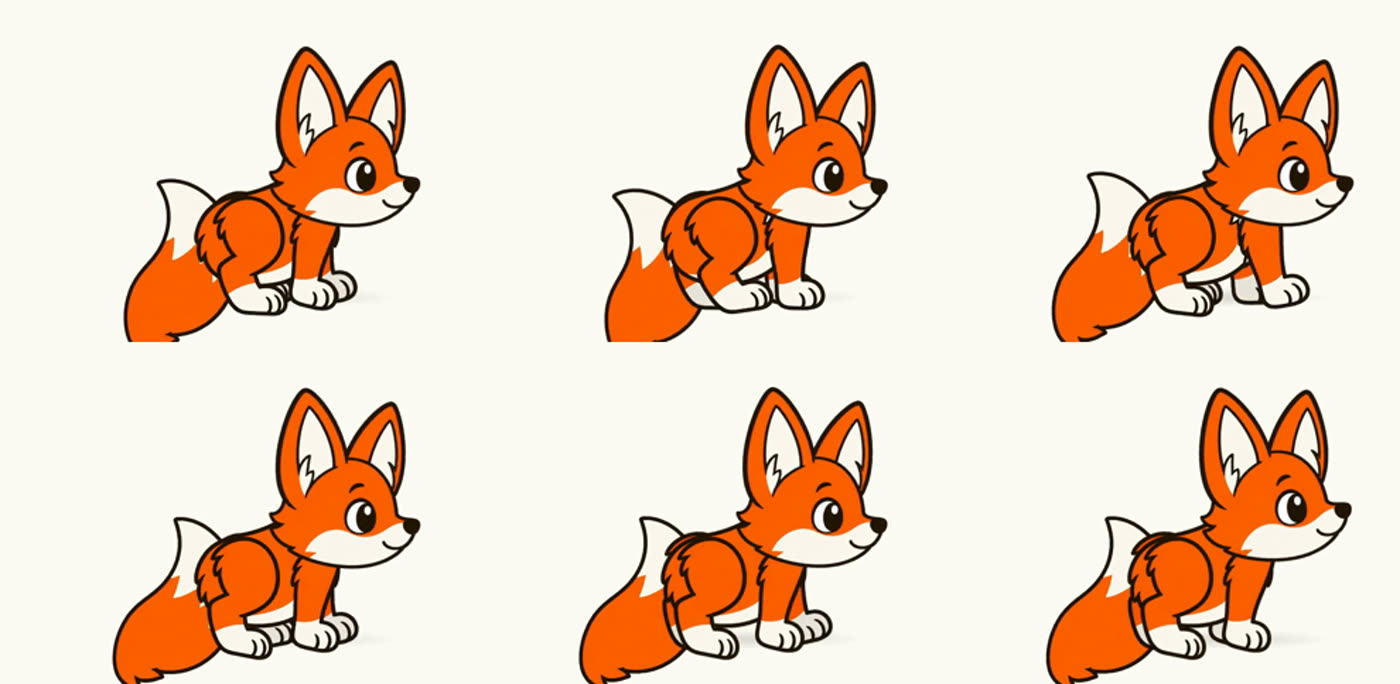
The grounding is a shadow doing physics.
A soft contact shadow sits under his feet the whole film. It pulses gently with the walk, and during the hop it shrinks and fades while he is airborne, then snaps back at the squash. Weight in animation is mostly shown at the contact point, and for a flat character the shadow is the contact point.
The blink got a grammar.
Lids close in 65 milliseconds and open in 120, because real blinks are asymmetric. But the placement matters more than the curve: blinks land where the gaze changes direction, and half blinks mark the smaller shifts of attention. In v3 the blinks were decoration on a schedule. Here they are punctuation.
Not one pixel of artwork, and not one new capability. The same six parts, the same toolchain, the same render time. Everything that reads as elegance is timing: which parts move together, which lag, what is linear and what is eased, and what never fully stops. The craft was all written down decades ago; the work was translating it into code.
What the build leaned on
Richard Williams, The Animator's Survival Kit: the four walk positions and their timing · archive.org full text
Brendan Body on walk cycles: the hips, chest, head cascade in frames · brendanbody.blogspot.com
Frank Thomas and Ollie Johnston, The Illusion of Life: follow through, overlapping action and drag · summary
Quadruped gait references: the four beat walk, front and back legs as offset systems · University of Minnesota veterinary anatomy · Animation Mentor
Rigged 2D practice: no easing on a planted foot · armanimation.com, walking in Spine
The moving hold · Animation Mentor · AnimSchool
What would move it further
- Sound, still. Four footfalls per stride are now real events; each deserves a soft step. This remains the largest lever untouched.
- A knee. The legs are single segments, so the swing is a straight sweep. Cutting each leg into two at the knee would buy the bent-leg passing position, which is the last visible gap in the gait.
- A turn to camera. One more parts sheet in three quarter view, and he could look at the viewer for the closing card.
Run on 22 August 2026 on an Apple M4 desktop. HyperFrames 0.8.8, headless Chrome and FFmpeg. Same rig parts as v3, unchanged. 660 frames rendered in 14.3 seconds. The checker passed with zero errors and caught one real timing bug during the build: two writers driving the head rotation in the same 30 milliseconds, which renders differently on a cold worker than on a warm one. The research above was done the same day, and the distilled rules were also written into the advisor that owns character motion, so the next character starts from them instead of rediscovering them.
Press Notes at the bottom right to mark up any block, or click any line to edit it directly.
Back to the topic · v3, the rig · v2, the pose library · v1, the pipeline · All explorations