Version 1 · 2026-07-17 · The Guided Flow
A short, cinematic sequence: show the outcome, prove the magic, ask one smart question, then get out of the way. Research-backed, and deliberately a hybrid — the middle path between a long quiz funnel and a bare camera.
The app ships 4 static screens today (Welcome · Snap · Find · Share → Sign in → AI consent). This is the proposed evolution.
The beat that sells the app — autoplays, flips on tap
Actual app · real captures
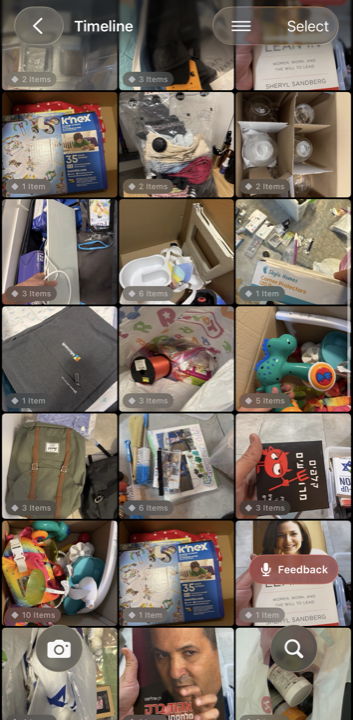
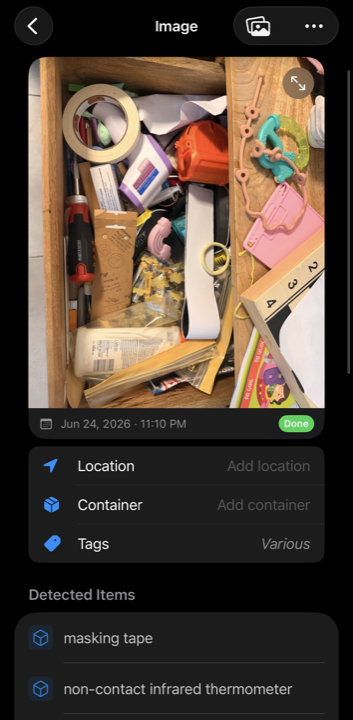
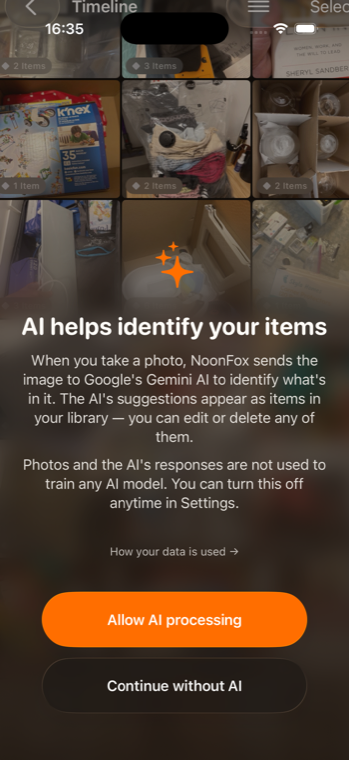
Not mockups — a real screen-recording and screenshots captured straight from NoonFox running on device today. The onboarding's whole job is to get someone to their own version of these screens, fast.
Actual screen-recording — a cold launch into a real, full Timeline


The flow · 11 beats, 3 phases
Phase 1 sells (no account, no wall). Phase 2 commits (question → sign-in → permission). Phase 3 activates (real snap → payoff → the ask).
Cold start
~82% of trials start day 0; the first frame must be the outcome demo, not a loading state. Fix the slow/offline first-open.
Welcome
One outcome promise, one line, zero tutorial. NN/g: tutorials give no task-success gain and make tasks feel harder.
The magic · autoplay demo
The one beat that sells NoonFox. Plays over a real screenshot, autoplays, flips on tap. Do two (home + garage) — see the live mockup up top.
Use-cases · ≤3
Passports & keys ("never tear the house apart before a flight"), expiration dates, storage unit. Fold the rest into one grid.
Family sharing
Close Phase 1 on the sticky, aspirational use-case. Family sharing is free — say so.
Segmentation
Single question lifts activation (+7.6pts in the Headspace test) — branch it wherever you can. Full detail in Personas.
Sign in
Duolingo moved signup behind first value and lifted DAU ~20%. Watch this beat for a drop-off cliff.
Camera permission · primed
Any reason lifts grants ~12%, a good one up to ~81%. iOS gives one shot — prime it, ask once.
First capture · the aha
For a compounding app the aha is the first find, which needs a few items. Success metric = items added.
Payoff
Reflect the input back, then run one natural-language search. This turns "feel seen" into a second session.
The ask
Reverse trial after the first find. Full argument in Money.
Housekeeping
Seeded ghost item tailored to the Step-5 answer. Onboarding shows max twice, then settings-only. Stall-email funnel for sign-ups who never capture.
The research · what works & what's a myth
1 · Show the outcome, never teach. NN/g: 94% task success skipping the tutorial vs 91% reading it, and readers rated tasks harder. Sell the result.
2 · Hit the aha in the first session. ~82% of trials start day 0; 55% of 3-day cancels happen day 0. Onboarding is the retention mechanism.
3 · Animate the magic over a real screenshot. Autoplay + manual override (NN/g / Material "Top Benefits"). The recognition pop is the payoff frame — the Cal AI moment.
4 · Cap standalone benefits at three; branch the rest. Material's ceiling. Sequence by emotional pull, not feature logic.
5 · Value before the signup ask. Duolingo's "product before signup" lifted DAU ~20%.
6 · Time permissions by context, and say why. Camera early + primed; notifications/location deferred.
The money
The recommendation
Don't pay-to-open. Capture 3–5 items free → one search (the aha) → then a reverse trial (7 days full premium, no card, downgrading to a limited free tier, not to nothing). Price around Cal AI's band (~$40–70/yr, annual default). NoonFox's value compounds — worthless at item #1, sticky at #50 — so gating on open charges for a promise, not a proof. Judge A/B tests on revenue-per-install & D30, never the headline conversion %.
The personas
Asking one goal question lifts activation just by making users feel seen (+7.6pts, Headspace) — but that lift is activation, not retention. So ask it and branch it: each answer must change the seeded locations, the sample search, or the hero framing, or it's fake personalization. 4 options + a "just exploring" escape hatch; single-select.
The ADHD wedge ("I lose things constantly"): lead with the lived symptom, never the diagnosis, to catch the undiagnosed majority. Go faster, defer the paywall, frame it as capacity ("remember unlimited things"), keep gamification quiet. Build it as one branch variable (copy, pace, paywall framing) — not a separate screen graph.
This is one direction. See the minimalist counter-take →
Open v2 · Camera-First